 Wildlife
of Madagascar
Aye-aye
Aye-aye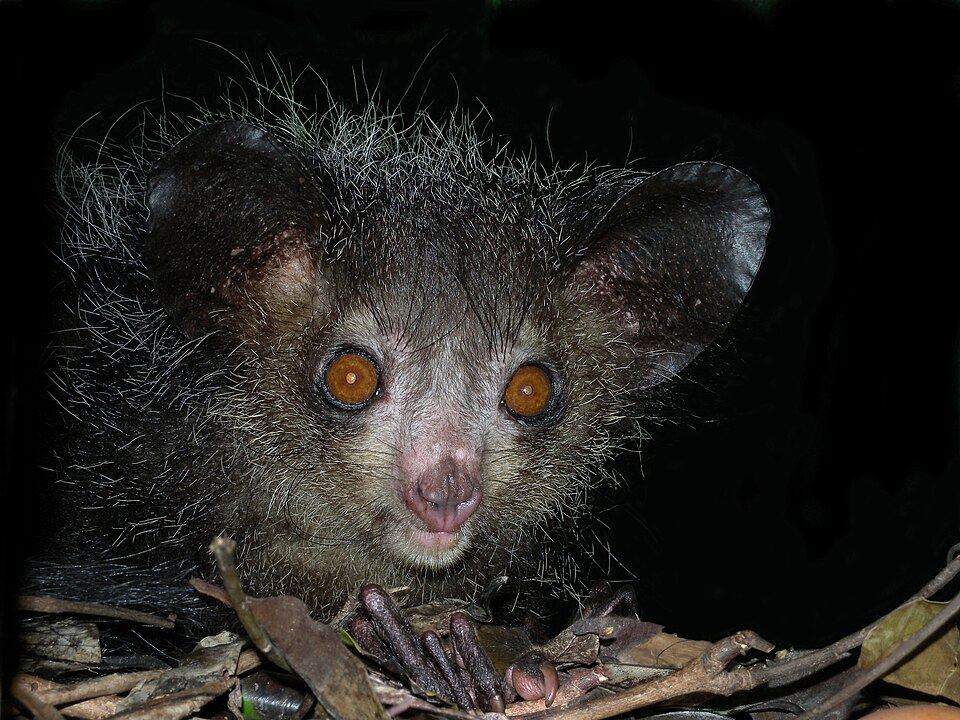
Photo: Frank Vassen from Brussels, Belgium · CC BY 2.0
Daubentonia madagascariensis
Basic stats
Diet
Wood-boring grubs and larvae found by tapping, plus seeds, fruit and nectar
Habitat
Primary and degraded rainforest, deciduous forest, littoral forest, mangrove, dry scrub and plantations, from sea level to about 1,875m
Range
Mainly the east, north and centre-west of Madagascar, in scattered populations; also introduced to Nosy Mangabe
Litter size
1
Gestation period
About 165 days
Size
Head and body 30–37cm; tail 44–53cm
Weight
About 2.4–2.6kg
The aye-aye is the largest nocturnal primate and one of the strangest. Its dark brindled coat is shaggy, with long blackish guard hairs tipped white, and its ears are huge, naked, black and constantly moving. The hands are black with very long fingers, and the third finger is thin and bony. The incisors never stop growing and the face is short with a pink, pointed nose (Wikipedia; Mittermeier et al. 2013, general species account).
It forages by percussive tapping: it taps on branches, listens for hollows, gnaws a hole through the wood and hooks out grubs with its thin finger, filling a niche taken by woodpeckers elsewhere. It sleeps by day in round nests of leaves and vines, rolled into a ball with its tail over its body. Individuals are largely solitary, males range more widely than females, and mating can occur at any time of year. It is often feared as a bad omen by some Malagasy communities (Wikipedia; Mittermeier et al. 2013).
Nine aye-ayes were released on Nosy Mangabe in 1966, and the island remains the best place to try for one on a night walk. On this guide it is a target species of Masoala, Nosy Mangabe and Marojejy.
Quick answers
- What does the Aye-aye eat?
- Wood-boring grubs and larvae found by tapping, plus seeds, fruit and nectar
- What habitat does the Aye-aye live in?
- Primary and degraded rainforest, deciduous forest, littoral forest, mangrove, dry scrub and plantations, from sea level to about 1,875m
- Where is the Aye-aye found?
- Mainly the east, north and centre-west of Madagascar, in scattered populations; also introduced to Nosy Mangabe
- What is the litter size of the Aye-aye?
- 1
- How long is the gestation period of the Aye-aye?
- About 165 days
- How big is the Aye-aye?
- Head and body 30–37cm; tail 44–53cm
- How much does the Aye-aye weigh?
- About 2.4–2.6kg