 Wildlife
of Madagascar
Fossa
Fosa, Mongooses & Other Carnivorans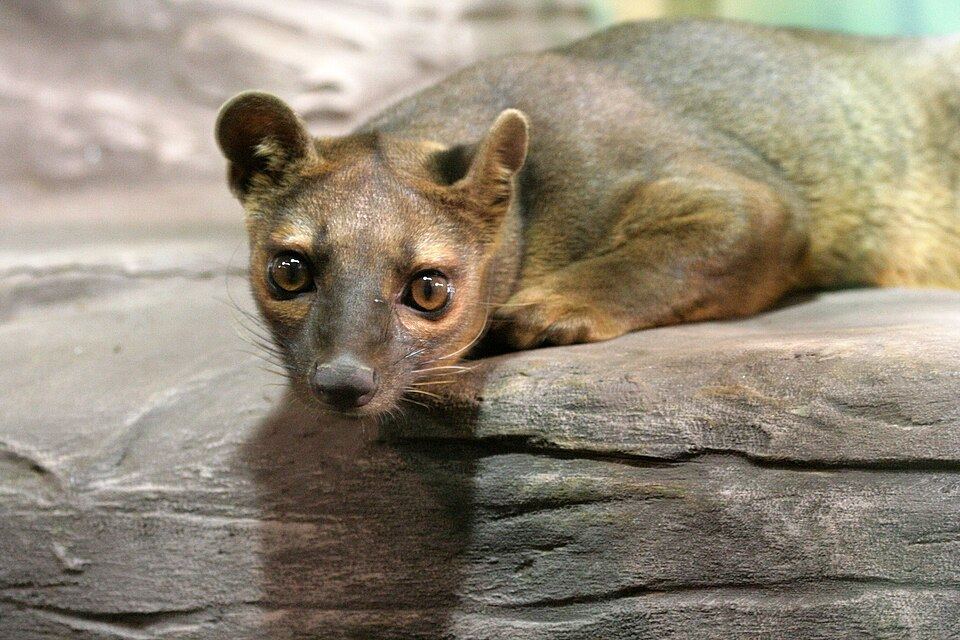
Photo: Dave Pape · Public domain
Cryptoprocta ferox
Basic stats
Diet
Over half lemurs; also tenrecs, rodents, lizards, snakes, birds, freshwater turtles and insects
Habitat
All forest types, from the wettest rainforest to the driest western and southern forest, from sea level to about 2,600m
Range
Madagascar-wide in remaining forest, but absent from the heavily disturbed central plateau
Litter size
1–6 pups, commonly 2–4
Gestation period
About 90 days
Size
Head and body 70–80cm; tail 65–70cm
Weight
Males 6.2–8.6kg; females 5.5–6.8kg
The fossa is the largest carnivoran on Madagascar, a lean, cat-like animal with a tail almost as long as its body, short reddish-brown fur and a mongoose-like head. Its semi-retractable claws and very flexible ankles let it run down tree trunks head first and leap between trees. Although it looks like a small cougar, it belongs to the Malagasy carnivoran family Eupleridae, whose members are related to mongooses (Wikipedia, general species account).
It hunts by day and night and is considered cathemeral, with irregular periods of activity. Lemurs make up over half the diet, including the larger diurnal species taken from their sleeping sites. Radio-collared animals in Kirindy had home ranges of up to 13km² for females and 26km² for males, and moved over 7km in a night. Mating occurs in trees, and the pups are born blind and toothless (Wikipedia; Wilson & Mittermeier 2009).
Many Malagasy people fear the fossa and a local taboo (fady) protects it in places. It is usually seen only by chance. On this guide it is a target species of Ankarana, Bemaraha and Kirindy.
Quick answers
- What does the Fossa eat?
- Over half lemurs; also tenrecs, rodents, lizards, snakes, birds, freshwater turtles and insects
- What habitat does the Fossa live in?
- All forest types, from the wettest rainforest to the driest western and southern forest, from sea level to about 2,600m
- Where is the Fossa found?
- Madagascar-wide in remaining forest, but absent from the heavily disturbed central plateau
- What is the litter size of the Fossa?
- 1–6 pups, commonly 2–4
- How long is the gestation period of the Fossa?
- About 90 days
- How big is the Fossa?
- Head and body 70–80cm; tail 65–70cm
- How much does the Fossa weigh?
- Males 6.2–8.6kg; females 5.5–6.8kg