 Wildlife
of Madagascar
Ring-tailed Lemur
Ring-tailed, Brown & Ruffed Lemurs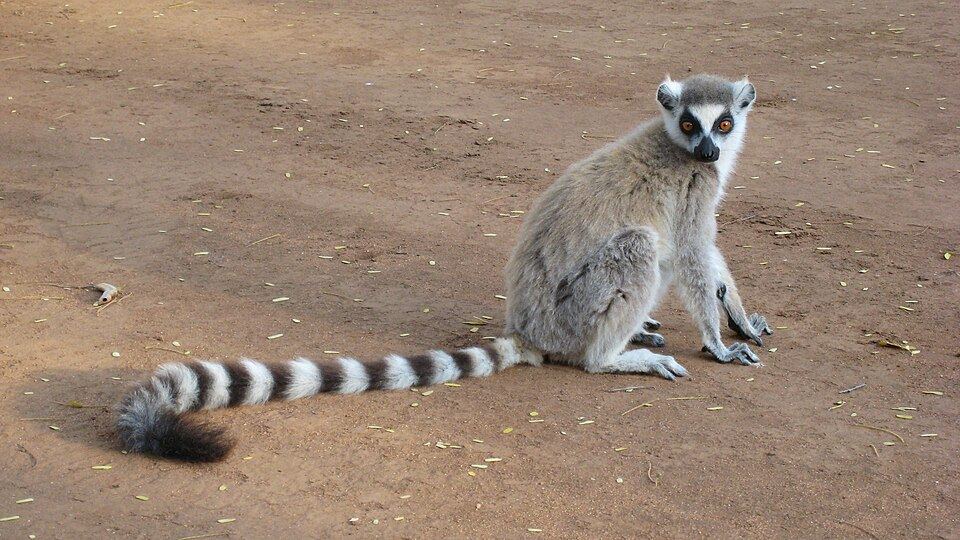
Photo: Alex Dunkel (Maky) · CC BY 3.0
Lemur catta
Basic stats
Diet
Fruit, young leaves, flowers, herbs, bark and sap from dozens of plant species, with kily (tamarind) a favourite; also insects and small vertebrates
Habitat
Gallery forest, spiny forest and dry scrub, ranging up onto rocky highland slopes
Range
South and south-west Madagascar, from Belo-sur-Tsiribihina on the west coast to near Tolagnaro, and inland to the Andringitra massif
Litter size
Usually 1, sometimes 2
Gestation period
About 135 days
Size
Head and body 39–46cm; tail 56–63cm
Weight
Around 2.5–2.9kg
The ring-tailed lemur is a medium-sized, grey-backed lemur with a white face framed by black triangular eye patches, a black nose and a tail ringed in black and white along its whole length (Wikipedia and Mittermeier et al. 2013, general species account). The cream belly and limbs, and eyes that range from bright yellow to red, complete a pattern that is unmistakable. A population on the high, cool Andringitra massif is darker, with thicker fur and fewer tail rings.
It lives in troops of about 6–24, sometimes more than 30, in which females are dominant over males. It is one of the most terrestrial lemurs and spends long periods on the ground, sitting upright with its belly turned to the sun. Males compete for females in 'jump fights' and 'stink fights', waving scented tails at rivals. Most births come in late August or September, and infants are carried first on the belly, then on the back (Wikipedia; Mittermeier et al. 2013).
On this guide it is a target species of Berenty, Isalo, Andringitra and Anja, and troops are used to people at the first two. Troops at Berenty and Anja are used to visitors.
Quick answers
- What does the Ring-tailed Lemur eat?
- Fruit, young leaves, flowers, herbs, bark and sap from dozens of plant species, with kily (tamarind) a favourite; also insects and small vertebrates
- What habitat does the Ring-tailed Lemur live in?
- Gallery forest, spiny forest and dry scrub, ranging up onto rocky highland slopes
- Where is the Ring-tailed Lemur found?
- South and south-west Madagascar, from Belo-sur-Tsiribihina on the west coast to near Tolagnaro, and inland to the Andringitra massif
- What is the litter size of the Ring-tailed Lemur?
- Usually 1, sometimes 2
- How long is the gestation period of the Ring-tailed Lemur?
- About 135 days
- How big is the Ring-tailed Lemur?
- Head and body 39–46cm; tail 56–63cm
- How much does the Ring-tailed Lemur weigh?
- Around 2.5–2.9kg